

Getting your soap box dimensions right is one of the most important decisions you will make as a soap brand. A box that is too big makes your soap slide around, looks unprofessional, and adds unnecessary shipping weight. A box that is too small will not close properly and can damage the product before it even reaches your customer.
Whether you are a small batch handmade soap maker selling at farmers markets, a growing natural soap brand selling through retail stores, or an established manufacturer producing soap at scale, understanding standard soap box dimensions will help you choose packaging that protects your product, fits your branding, and keeps your costs under control.
This guide covers every standard soap box size across different soap types, explains the dimensions in both inches and centimetres, covers the most common box styles used in soap packaging, and explains how to measure your soap correctly to get the right fit every time. If you are ready to order custom soap boxes that fit your specific soap dimensions perfectly, The Pioneer Packaging offers full customisation with no minimum order requirement and free shipping across the USA.
Why Soap Box Dimensions Matter
Before getting into specific measurements, it is worth understanding why getting the dimensions right matters as much as it does.
Product protection is the first reason. A well-fitted soap box holds the soap securely so it does not move during shipping or retail handling. Movement inside the box causes the soap to chip, crack, or have its edges worn down, which damages the product before the customer even opens it.
Professional presentation is the second reason. When a customer picks up a soap box at a retail shelf, the fit of the packaging sends an immediate signal about the quality of the brand. A box that feels slightly too large or that rattles when shaken makes the product feel cheap, regardless of how good the soap actually is.
Shipping cost efficiency is the third reason. As covered in our guide to how packaging dimensions affect shipping costs, carriers charge based on dimensional weight, meaning the size of your package determines the cost even more than the actual weight in many cases. A soap box that is 1 inch larger than necessary in each dimension can meaningfully increase your shipping cost across thousands of units.
Material efficiency is the fourth reason. Every extra square inch of paperboard in an oversized box is wasted material. For brands with sustainability goals, right-sizing packaging is a direct way to reduce material consumption and packaging waste.
How to Measure Your Soap Before Choosing a Box
The most important step before selecting any box size is measuring your actual soap accurately. This sounds obvious, but it is where many soap brands make mistakes that lead to ill-fitting packaging.
Measure your soap in three dimensions: length, width, and height. Length is the longest side of the bar. Width is the shorter horizontal dimension. Height is how tall the bar is when it sits flat.
For handmade and cold process soaps, measure after curing is complete. Soap loses moisture during curing, which means it shrinks slightly. A bar measured before curing will be slightly larger than the bar your customer actually receives. If you measure before curing and order boxes to match, the cured soap may rattle inside a box sized for the uncured bar.
After measuring your soap, add 2 to 3mm of clearance on each dimension to the internal box size. This allows the soap to sit snugly without being squeezed, leaves room for any slight size variation between individual bars, and makes it easy to slide the soap in and out of the box without catching on the edges.
For soaps wrapped in tissue paper, wax paper, or fabric before being boxed, measure the wrapped soap rather than the bare bar and add the same 2 to 3mm clearance on top.
Standard Soap Bar Dimensions
Before looking at box sizes, it helps to know the standard dimensions of the soap bars that most boxes are designed around.
A standard mass-produced soap bar, like those produced by brands such as Dove, Ivory, and Irish Spring, typically measures approximately 3.5 to 3.75 inches long, 2.25 to 2.5 inches wide, and 0.875 to 1 inch tall. These dimensions represent the most widely produced soap bar format in the world and are the baseline around which most standard soap box sizes are designed.
Handmade and cold process soap bars are generally larger and thicker than mass-produced bars. A typical handmade bar measures approximately 3.5 to 4 inches long, 2.5 to 2.75 inches wide, and 1 to 1.5 inches tall. The greater height of handmade bars is because they are often cut from a loaf in thicker slices than industrial bars and because they retain more moisture during the curing process.
Guest soaps, which are small bars designed for use in bathrooms as single-use or limited-use amenity soap, typically measure approximately 2.25 to 2.5 inches long, 1.5 to 1.75 inches wide, and 0.5 to 0.75 inches tall.
Luxury and specialty soaps can vary considerably from these standard dimensions because they are often shaped into novelty forms, made in round or square formats, or produced in extra-large bars designed to last longer or to be used as gifts.
Standard Soap Box Dimensions by Size Category
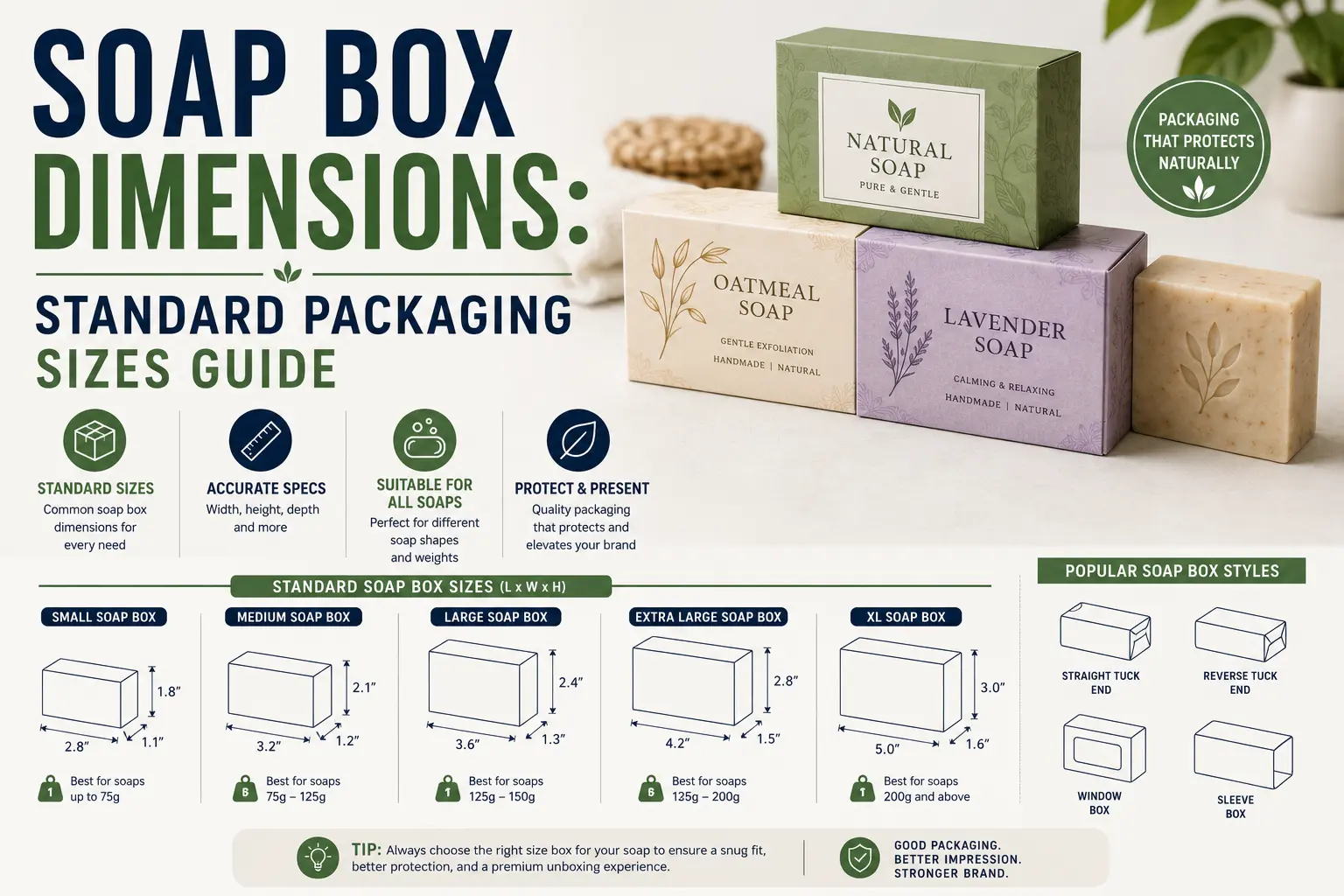
Soap boxes are typically categorised by the size of soap they are designed to hold. Here is a comprehensive breakdown of every standard size category with typical dimensions.
Mini or Sample Soap Box
Typical internal dimensions: 2 × 1.25 × 0.75 inches (50.8 × 31.75 × 19.05 mm)
Mini soap boxes are used for sample-size soaps, guest soaps, hotel amenity soaps, and soaps included in gift sets or subscription boxes. These are the smallest standard soap box size and are designed for bars weighing approximately 10 to 30 grams.
Mini soap boxes are popular for skincare brands offering sample products at a lower price point to attract new customers, for hotels and hospitality businesses sourcing small amenity soap packaging, and for gift hamper brands that include a small soap as part of a larger set.
The very small dimensions of mini soap boxes require precise die-cutting and accurate internal sizing because there is very little tolerance for error at this scale.
Small Soap Box
Typical internal dimensions: 2.25 × 1.5 × 0.875 inches (57.15 × 38.1 × 22.22 mm)
Small soap boxes are designed for guest-size bars and smaller standard bars weighing approximately 30 to 60 grams. This size sits between the mini format and the standard size, and is popular for travel soap bars, gift soap sets, and product lines that offer a smaller-sized version of their main bar.
Standard Soap Box (Most Common)
Typical internal dimensions: 3.75 × 2.5 × 1.25 inches (95.25 × 63.5 × 31.75 mm)
The standard soap box is the most widely used soap packaging size in the industry. It is designed to hold a typical 3.5 to 3.75 inch soap bar with the 2 to 3mm clearance needed for a snug fit. Most retail soap brands, handmade soap sellers, and mass-market soap producers use a box in or very close to this size range.
Some sources list the standard soap box as 2 × 3 × 1.125 inches, which represents an older and slightly smaller convention from the mass-production era when commercial soap bars were uniformly smaller. Today, the 3.75 × 2.5 × 1.25 inch internal dimension is the more accurate standard for most soap being produced and sold.
External dimensions of a standard soap box in 18-point paperboard are typically approximately 3.875 × 2.625 × 1.375 inches, adding the board thickness to each dimension.
Average or Medium Soap Box
Typical internal dimensions: 3.75 × 2.75 × 1.25 inches (95.25 × 69.85 × 31.75 mm)
The average or medium soap box is slightly wider than the standard size to accommodate thicker or more textured soap bars, handcrafted soaps with irregular edges, and decorative soaps with embossed designs that add to the width of the bar. This is a popular size for artisan soap brands whose bars tend to be slightly larger and less uniform than mass-produced bars.
Large Soap Box
Typical internal dimensions: 4 × 3 × 1.5 inches (101.6 × 76.2 × 38.1 mm)
Large soap boxes are used for bigger soap bars, thick handmade bars, specialty soaps, and bars weighing approximately 150 to 200 grams. They are also used for wrapped soaps where the wrapping adds to the overall dimensions of the packaged bar. Many artisan and luxury soap brands prefer the large size because it gives a more generous, premium feel in the hand even when the soap itself is a standard weight.
Extra Large or Family Size Soap Box
Typical internal dimensions: 4.5 × 3.25 × 1.75 inches (114.3 × 82.55 × 44.45 mm)
Extra large soap boxes are designed for oversized bars, family-size soaps, and multiple soap bars packaged together in a single box. Soap bars in this category typically weigh 200 to 300 grams or more. This size is also used for soaps in novelty or decorative shapes that have a larger footprint than a standard bar.
Jumbo Soap Box
Typical internal dimensions: 6 × 4.5 × 2 inches (152.4 × 114.3 × 50.8 mm)
Jumbo soap boxes are used for multi-packs, oversized soaps, special edition collections, and gift sets containing a soap bar plus a complementary product such as a loofah, a small candle, or a travel bag. This format is popular for seasonal gift packaging and subscription box inclusions where the larger box size allows for a more elaborate presentation.
Standard Soap Box Dimensions Quick Reference Table
| Category | Internal Dimensions (inches) | Internal Dimensions (mm) | Typical Soap Weight |
|---|---|---|---|
| Mini / sample | 2 × 1.25 × 0.75 | 50.8 × 31.75 × 19.05 | 10 to 30g |
| Small | 2.25 × 1.5 × 0.875 | 57.15 × 38.1 × 22.22 | 30 to 60g |
| Standard | 3.75 × 2.5 × 1.25 | 95.25 × 63.5 × 31.75 | 90 to 120g |
| Medium / average | 3.75 × 2.75 × 1.25 | 95.25 × 69.85 × 31.75 | 100 to 140g |
| Large | 4 × 3 × 1.5 | 101.6 × 76.2 × 38.1 | 150 to 200g |
| Extra large | 4.5 × 3.25 × 1.75 | 114.3 × 82.55 × 44.45 | 200 to 300g |
| Jumbo / multi-pack | 6 × 4.5 × 2 | 152.4 × 114.3 × 50.8 | 300g and above |
Soap Box Dimensions for Specialty Soap Types
Beyond the standard rectangular bar soap, several specialty soap formats require their own box dimensions.
Square Soap Boxes
Square soaps are a popular format in artisan and premium soap making. A typical square soap measuring 2.5 × 2.5 × 1.1 inches needs a square box with internal dimensions of approximately 2.6 × 2.6 × 1.25 inches. Square boxes are less commonly available as standard off-the-shelf sizes from packaging suppliers, so custom sizing is often required.
Round Soap Boxes
Round soaps require either a round box, which is a specialist format, or a square box that accommodates the diameter of the soap bar. For a round soap with a 3-inch diameter, a square box with 3-inch internal dimensions on each side accommodates the soap with a small amount of clearance at the corners. Some brands use a round window box that allows the circular shape of the soap to show through the top panel.
Luxury and Premium Soap Boxes
Luxury soaps are often larger and heavier than standard bars, reflecting the premium ingredients and longer production times involved. A luxury soap bar might measure 4 × 3 × 1.75 inches or larger, requiring a box in the large to extra-large range. Luxury soap packaging also typically uses heavier board, higher-quality printing, and premium finishes like foil stamping and soft-touch lamination to match the premium positioning of the product.
Liquid Soap and Soap Dispenser Boxes
Liquid soap packaged in bottles or pump dispensers requires a completely different box format from bar soap. A standard 8oz liquid soap bottle in a pump dispenser typically measures approximately 2.5 inches in diameter and 7 to 8 inches tall. The box for this product is a tall, narrow format typically measuring approximately 3 × 3 × 8 inches internally to accommodate the bottle with clearance on all sides.
Multi-Bar Gift Sets
Soap gift sets containing two, three, or four bars in a single box are a popular retail format, particularly for seasonal gifting. A two-bar gift set using standard-size bars needs a box approximately 7.5 × 2.5 × 1.25 inches internally if the bars are arranged side by side, or approximately 3.75 × 2.5 × 2.5 inches if they are stacked. A four-bar gift set arranged in a 2 × 2 grid needs a box approximately 7.5 × 5 × 1.25 inches internally.
Soap Box Styles and Their Dimensions
The style or construction of the box affects not only its dimensions but also how it is assembled, how the customer opens it, and how it presents the product.
Tuck End Box (Straight Tuck or Reverse Tuck)
The tuck end box is the most widely used soap box construction. The box is cut from a single flat sheet of paperboard, folded into shape, and closed at the top and bottom by tuck flaps that slide into the box interior. No tape or glue is needed after the box is assembled at the factory.
Tuck end boxes are cost-effective, lightweight, easy to store flat before use, and available in virtually any size. They are the default choice for most retail soap brands at standard to medium price points. The reverse tuck end, where the top and bottom tuck in opposite directions, is slightly more secure than the straight tuck and is more common for soap packaging.
Sleeve Box (Soap Sleeve or Belly Band)
A sleeve box wraps around the soap bar rather than fully enclosing it. It covers the middle section of the bar while leaving the top and bottom ends of the soap exposed. Sleeve boxes use significantly less material than full enclosure boxes, which makes them less expensive and more sustainable.
Sleeve boxes are popular with natural and organic soap brands because the exposed soap surface allows the customer to see and smell the actual product before buying. The sleeve dimensions must match the width of the soap bar precisely to prevent the sleeve from sliding off.
A standard sleeve for a 3.75 × 2.5 × 1.25 inch soap bar typically measures approximately 5.5 × 2.6 inches when flat, wrapping around the 3.75-inch length with a small overlap for closure.
Drawer Box (Slide Out Box)
A drawer box consists of an outer sleeve and an inner tray that slides out like a drawer. This style creates a premium, deliberate opening experience and is associated with luxury and artisan soap packaging. The sliding reveal of the soap inside creates a moment of anticipation that simple tuck boxes cannot match.
Drawer boxes require two separate components, which makes them more expensive to produce than tuck end boxes, but the premium unboxing experience justifies the cost for higher-price-point soap products.
Window Box
A window box incorporates a clear panel cut into one or more faces of the box, allowing the soap to be seen through the packaging. Windows are popular in soap packaging because seeing the actual soap, including its colour, texture, marbling, and embedded ingredients, is a powerful selling point particularly for handmade and artisan soaps.
Window boxes are available in most standard soap box sizes. The window can be positioned on the top panel, the front panel, or both. The clear panel is typically made from PET film glued to the inside of the die-cut opening.
Two-Piece Rigid Box
A two-piece rigid box consists of a separate base tray and lid made from thick chipboard, similar to a luxury gift box. It does not fold flat and is permanently assembled. Rigid soap boxes are used exclusively for premium and luxury soap products where the box itself is part of the gift experience. The weight and rigidity of the box communicates quality and permanence.
Rigid soap boxes are significantly more expensive than folding carton alternatives and are typically used for soaps retailing above $15 to $20 per bar.
Materials Used in Soap Boxes
The material your soap box is made from affects its appearance, strength, sustainability, moisture resistance, and cost.
Cardstock and SBS Paperboard
Solid Bleached Sulphate board is the standard material for most retail soap boxes. It provides a smooth white surface ideal for high-quality printing, adequate rigidity to protect the soap, and food-contact safety relevant to a personal care product. Standard board weights for soap boxes range from 16 to 24 point depending on box size and product weight.
Kraft Paperboard
Kraft board is the natural, unbleached alternative to white SBS board. Its brown, textured surface is immediately associated with natural, organic, handmade, and eco-conscious products. Kraft soap boxes are extremely popular in the artisan and indie soap market. They print well with earthy, simple designs that complement the natural aesthetic of the material itself.
Recycled Content Board
Recycled paperboard uses post-consumer recycled fibre in some or all plies of the board. It is a more sustainable choice than virgin fibre board and is increasingly specified by brands with environmental commitments. Performance for soap packaging applications is comparable to virgin board for most size and weight combinations.
Rigid Chipboard
Thick chipboard, typically 1.5mm to 2mm, is used for premium and luxury soap boxes. It is significantly heavier and more rigid than standard paperboard, producing a box that feels substantial and permanent. Chipboard boxes are typically covered with a printed paper or fabric wrap rather than being directly printed.
Printing and Finishing for Soap Boxes
Soap packaging is one of the most creatively active categories in consumer goods. The visual presentation of a soap box directly influences purchase decisions, particularly in retail environments where dozens of competing products sit side by side on the same shelf.
Printing Methods
Offset lithographic printing is the standard for soap boxes at medium to large volumes. It produces photographic quality colour and is cost-effective above approximately 500 to 1,000 units. Digital printing is ideal for short runs from as few as 50 units, allowing small soap brands to create professional packaging without committing to large minimum quantities.
Surface Finishes
Gloss lamination is the most popular finish for soap boxes targeting a vibrant, bold retail presence. Matte lamination is preferred by premium and luxury soap brands for its understated, sophisticated appearance. Soft-touch lamination creates a velvety texture that makes the box feel premium when held. Spot UV gloss applied selectively over a logo or design element creates a striking contrast against a matte base.
Special Finishes
Foil stamping in gold, silver, rose gold, or holographic foil is widely used in luxury soap packaging to communicate premium quality and visual distinction. Embossing and debossing create raised or recessed textures in the box surface, adding a tactile dimension that standard printing cannot achieve.
How to Choose the Right Soap Box Dimensions for Your Brand
Choosing the right soap box size is a combination of measuring accurately and thinking about how the box will perform across all the situations it will encounter from production through to the customer’s bathroom shelf.
Start by measuring your soap after curing and add 2 to 3mm of clearance on each dimension to arrive at your target internal box dimensions. Then consider whether you need any of these adjustments.
If your soap varies in size between batches, as handmade soap often does, choose a box that comfortably fits the largest bars you produce rather than the average bar. A box that is slightly generous is better than one where some bars do not fit.
If your soap will be wrapped in tissue paper or wax paper before boxing, measure the wrapped bar to get your target internal dimensions.
If your soap has embossed designs, rounded edges, or irregular shapes, add an extra 2 to 3mm of clearance beyond the standard tolerance to ensure the soap can be inserted and removed without catching on box edges.
If your soap will be displayed on retail shelves, consider how the box orientation affects shelf presence. A taller box with a smaller footprint creates a different shelf impression from a flatter, wider box of equivalent internal volume. Taller boxes tend to be noticed more easily from further down the aisle.
Once your dimensions are confirmed, choosing the right box style comes down to your brand positioning and price point. Tuck end boxes in kraft or printed paperboard suit most natural and mid-range soap brands well. Window boxes work particularly well for visually distinctive soaps where the product itself is the best marketing tool. Rigid boxes are the right choice when the soap price and brand positioning justify the packaging investment.
For brands ready to move beyond standard sizes and develop packaging that perfectly fits their specific soap dimensions, The Pioneer Packaging offers custom cosmetic boxes designed specifically for soap and skincare products, with full printing and finishing customisation, no minimum order requirement, and free shipping across the USA.
Soap Box Dimensions and Shipping Costs
For soap brands selling through e-commerce and shipping direct to customers, the dimensions of the soap box have a direct effect on the cost of every shipment.
A standard soap box measuring approximately 3.875 × 2.625 × 1.375 inches in external dimensions has a volume of approximately 14 cubic inches. This is a compact, dense package whose actual weight typically exceeds its dimensional weight, meaning most soap boxes ship on actual weight rather than dimensional weight. This is good news for soap brands because it means the dense, heavy nature of soap actually works in their favour for shipping cost purposes.
Where dimensional weight does become a concern is in gift set packaging and multi-bar boxes. A jumbo gift set box measuring 6 × 4.5 × 2 inches externally has a volume of 54 cubic inches and a dimensional weight of approximately 0.4 pounds. A 300-gram (approximately 0.66 pound) soap gift set in this box would ship on actual weight, but a lighter gift set might not.
For soap brands building a direct-to-consumer shipping operation, right-sizing both the soap box and the outer shipping mailer is important. A soap box that fits snugly in a standard poly mailer or small corrugated mailer box with minimal void fill will always ship more economically than one requiring a larger outer shipper.
FAQs
What are the standard dimensions of a soap box?
The most common standard soap box measures approximately 3.75 × 2.5 × 1.25 inches internally. This accommodates a standard bar soap of approximately 3.5 to 3.75 inches long, 2.25 to 2.5 inches wide, and 1 inch tall with a 2 to 3mm snug-fit clearance.
What are the dimensions of a soap box for handmade soap?
Handmade soap bars are generally larger than commercial bars. A typical handmade soap box has internal dimensions of 3.75 × 2.75 × 1.25 inches for standard handmade bars, or 4 × 3 × 1.5 inches for thicker or heavier handmade bars. Always measure your specific soap after curing before ordering boxes.
How much bigger should a soap box be than the soap?
The internal dimensions of the soap box should be 2 to 3mm larger than the soap on each dimension. This allows a snug fit that holds the soap securely without squeezing it. For wrapped soaps, measure the wrapped bar and add the same clearance.
What is the standard soap box size in centimetres?
A standard soap box in centimetres has internal dimensions of approximately 9.5 × 6.4 × 3.2 cm (length × width × height). Mini boxes are approximately 5.1 × 3.2 × 1.9 cm and large boxes are approximately 10.2 × 7.6 × 3.8 cm.
What material is best for soap boxes?
SBS paperboard is the standard material for retail soap boxes offering good printability and rigidity. Kraft board is popular for natural and artisan soap brands. Recycled content board is the most sustainable option. Rigid chipboard is used for premium and luxury soap packaging.
What is a sleeve soap box?
A sleeve soap box is a wrap-around band that covers the middle section of the soap bar while leaving the top and bottom ends exposed. It uses less material than a full enclosure box, is popular in natural and eco-conscious soap packaging, and allows customers to see and smell the actual soap before buying.
Can soap boxes have windows?
Yes. Window soap boxes incorporate a clear PET film panel in the top or front of the box, allowing the soap to be seen through the packaging. Window boxes are popular for handmade and artisan soaps where the visual appearance of the bar is a key selling point.
How do I measure my soap for box sizing?
Measure the length, width, and height of your soap after curing is complete using a ruler or caliper. Add 2 to 3mm to each measurement to get your target internal box dimensions. If your soap is wrapped before boxing, measure the wrapped bar instead.
Getting Your Soap Box Dimensions Right
Soap box dimensions are not a detail to leave until the end of the packaging design process. They are a foundational decision that affects how your product is protected, how it looks on the shelf, how much it costs to ship, and what impression it makes when a customer picks it up for the first time.
The standard sizes in this guide cover the vast majority of soap bar formats, from mini guest bars to luxury oversized bars and multi-pack gift sets. Starting with the standard size closest to your soap dimensions and adjusting by 2 to 3mm for clearance will get most soap brands to the right box size quickly and accurately.
For brands that need custom dimensions, specialty finishes, or distinctive box styles that go beyond standard off-the-shelf options, working with a packaging supplier that understands the soap and personal care category is the most efficient path to packaging that works. The Pioneer Packaging specialises in custom product boxes for every soap type and brand positioning, offering custom sizing, premium printing, and finishing options from foil stamping to soft-touch lamination, with no minimum order and free USA shipping to help brands of every size get professional packaging without unnecessary risk or investment.