

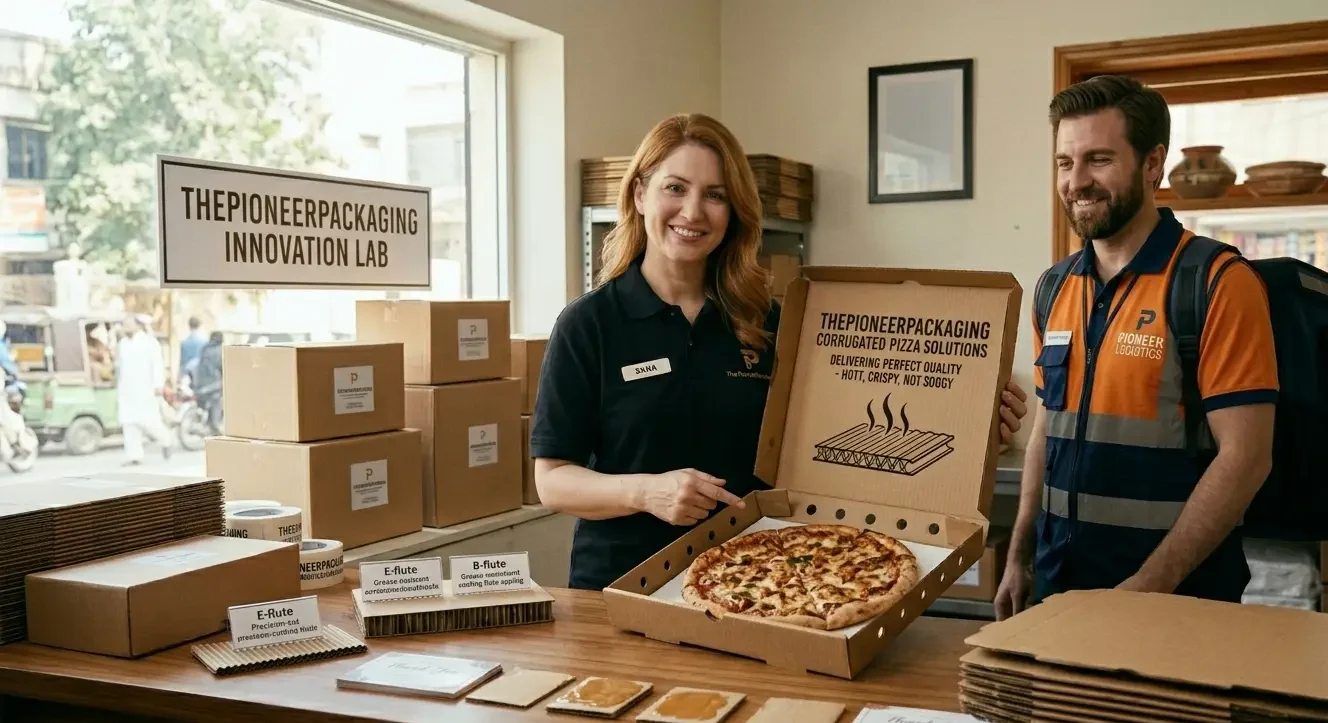
The pizza left the oven perfect. Twenty minutes later it shows up lukewarm, the crust is floppy and half the cheese is glued to the lid. Sound familiar? For a lot of pizzerias and delivery brands, the plain old pizza boxes they’ve always used are quietly costing them reviews, remakes and repeat customers.
This guide walks through why more shops are moving to corrugated pizza packaging, which alternatives are actually worth trying, and how we’d pick one for your menu and your delivery routes.
Why Traditional Pizza Boxes Are Becoming Outdated
Common problems with standard pizza boxes. The thin, cheap boxes go soft fast. A humid night or a long drive and the lid sags right onto the toppings.
Why pizzas get soggy on the way. Steam. A hot pie throws off a lot of it, and if the box has nowhere for it to go, it condenses on the lid and drips back down onto the crust, which is how you get that limp, wet slice nobody wants.
Packaging waste in food delivery. Single-use boxes pile up in landfills, and cities and customers are both paying more attention to that than they used to.
The real cost of cheap boxes. Paper prices bounce around. Add the remakes and refunds from crushed or soggy pies and the “cheap” box isn’t cheap anymore. (We’d rather see a shop spend a little more on decent custom packaging than eat those refunds every Friday night.)
And people do care about waste now. Some of your regulars will pick the place with the eco-friendly packaging over the one without it, all else equal.
So that’s the push. Too much trash, bad deliveries, boxes nobody remembers.
What Makes Corrugated Material Ideal for Pizza Packaging?
Quick refresher on what corrugated even is: two flat liner sheets with a wavy layer, the flute, glued in the middle. Those tiny air channels make the board stiff and a bit springy, and they hold heat better than you’d expect, without adding much weight at all.
Single-wall or double? Single-wall handles most pizza runs fine. Double-wall is for the catering order where a driver stacks eight boxes on the passenger seat and does four stops, and we wrote up single, double and triple wall corrugated separately if you want the deep dive.
About food safety. The inside surface touches your pizza, so it needs a food-grade liner or coating that can take grease and heat, and it’s totally fine to ask your box maker exactly what they use there.
Then heat. The trapped air in the flutes slows things down, so a pie in corrugated is warmer at the door than one in a flimsy box. Add a few vent holes or small perforations and steam gets out while most of the heat stays put, which is the biggest single fix for soggy crust we know of.
Best Pizza Box Alternatives Using Corrugated Material
Corrugated pizza trays are the barebones option, a flat tray with low walls that folds in a couple of seconds, and shops that switch to them usually toss out way less board at the end of the night.
Clamshells come next. Slices, personal pies, takeout. The lid locks shut so nothing slides out in the bag, and for single slices our pizza slice boxes are what most shops order from us.
Then there’s the vented corrugated pizza box, which is honestly the one we push hardest, because a couple of side vents and the “my pizza came soggy” messages mostly stop.
Sleeves? Handy for slices or small pies. Barely any material and a nice flat face for your logo.
Foldable delivery packs live flat in a stack until the Friday rush hits, then pop together in a second or two, and if your back room is the size of a closet you’ll love that.
Last one, the corrugated plus compostable hybrid, where you keep the stiff corrugated shell but use a compostable liner or lid. Customers who care about this kind of thing do notice.
Not sure which to try? Ask us for corrugated packaging samples, put two or three through a real Saturday delivery and see which one your drivers like.
How Sustainable Corrugated Packaging Improves Pizza Delivery
Long runs are where you feel it first. A decent corrugated box keeps the pie warm for the extra ten minutes across town, so “it was cold” stops showing up in your reviews.
Grease is the next thing. With a grease-resistant coating on the inside, the oil stays in the box instead of on the driver’s seat or the customer’s jeans.
And the unboxing (yes, for pizza). Sounds silly. It isn’t, a sturdy printed box makes the place feel like it cares.
On the green side, corrugated often has recycled fiber in it and it’s easy to recycle again after, so the footprint tends to be smaller than heavier options. Plenty of local programs take lightly greasy boxes, some don’t, check yours. A few newer styles throw compostable parts into the mix too.
Corrugated Pizza Packaging vs Traditional Pizza Boxes
Cost. Upfront it’s about the same or a touch more, but you make it back with fewer ruined pies.
Durability. Corrugated wins, easily. It stacks better and shrugs off moisture and crushing.
Sustainability. Usually more recycled content, and it actually gets recycled more often too.
Storage. Lots of corrugated styles ship and store flat, so you get back shelf space.
Branding. A smooth corrugated surface takes print and finishes far better than thin cheap board. That’s why custom printed pizza boxes are almost always corrugated.
| Feature | Traditional Cardboard | Corrugated Pizza Packaging |
|---|---|---|
| Durability | Moderate | Excellent |
| Heat Retention | Poor | Superior |
| Ventilation Options | Limited | Excellent |
| Sustainability | Average | High |
| Branding Potential | Basic | Premium |
| Long-term Cost | Higher (due to claims) | Better ROI |
Our take: corrugated for anything going out on delivery in volume. Thin boxes only make sense for a few pickup orders across the counter.
How to Choose the Right Corrugated Pizza Packaging
Start with the flute. E-flute is thin and takes print really nicely, while B-flute and C-flute are thicker and cushion more, so for a big 16 or 18 inch pie we’d go B.
Next, the inside. Insist on a food-safe grease barrier, or the oil soaks through and the box goes limp halfway to the customer.
Print is where you get your money back. A logo, a QR code to the menu, this week’s deal, and every box that leaves the shop sits on someone’s kitchen table for an hour.
Size it snug. A box that’s an inch too big lets the pie slide into a corner, and you’re paying for board you don’t need.
How far do your drivers go? Long routes want double-wall or extra insulation, but a ten-minute local run is fine in a light vented single-wall box.
Buying in bulk, we’d order ahead of your busy season and cut down to fewer sizes across the menu, since bigger runs of each size bring the price per box down.
Common Mistakes Restaurants Make With Pizza Packaging
- No vents, then wondering why every crust shows up soggy
- Using board that isn’t food-safe on the inside
- Buying on price alone and paying for it in remakes
- Boxes so big the pie slides into a corner
- Plain brown boxes with no logo, which is a wasted chance to get remembered
Fix those and you’ll feel it in your reviews pretty quickly.
Future Trends in Eco-Friendly Pizza Packaging
Compostable corrugated is the one to watch, since the newer plant-based coatings handle heat and grease a lot better than they did a few years back.
Smart packaging is creeping in slowly. Temperature dots, QR codes that link to the order, stuff like that, and it’s getting cheap enough for a regular neighborhood shop to play with.
Designs are also getting leaner. Same job, noticeably less board.
Reusable carriers are being tested by a few chains. Deposit, hand it back to the driver next time. Big ask, we’ll see.
AI-driven packaging optimization exists too, where software reads your menu and routes and spits out box sizes and vent spots, but it’s early.
FAQ: Corrugated Pizza Packaging
What are the best alternatives to traditional pizza boxes? We’d say vented corrugated boxes first, then clamshells for slices, then the corrugated and compostable hybrids if green matters a lot to your crowd, since all three hold up way better on an actual delivery than thin board does.
Is corrugated material safe for food packaging? It is when the liner and coating are food-grade and made for direct contact. So just ask whoever makes your boxes what’s on the inside surface, any decent supplier will tell you.
Can corrugated pizza packaging be recycled? Yes, and it’s one of the most recycled materials out there, though your city might want the really greasy bottom torn off first.
Which corrugated flute type is best for pizza boxes? We’d say B-flute for most shops and E-flute if the print is the star.
How do ventilated pizza boxes prevent sogginess? The steam gets out through the holes instead of sitting on the lid and dripping back down.
Are eco-friendly pizza boxes more expensive? A bit, sometimes, at first. Then the remakes drop.
What is the most sustainable pizza packaging option? Probably a high recycled-content corrugated box that goes straight in the recycling, or a corrugated and compostable hybrid. Both work fine on the road.
Can corrugated packaging keep pizza hot longer? Yes, that air trapped in the flutes slows the heat loss compared to a thin box.
How can restaurants customize corrugated pizza packaging? Most shops start with a logo on the lid and maybe a QR code for the menu, and from there you can go to full-color print, special coatings, embossing or a totally custom shape.
What packaging works best for pizza delivery services? A vented corrugated box, single or double wall depending on how far your drivers go and how big the orders get.
Conclusion
Thin pizza boxes hold a lot of shops back. Soggy crust, piles of trash, zero branding, and all of it fixable, because a stiffer corrugated box with vents and a printed lid handles the steam, survives the drive and still goes in the recycling bin after.
So, short version:
- Corrugated protects better and keeps heat in longer
- Vents are what keep the crust crisp
- The greener options hold up as well as the old boxes now, often better
Ready to switch? Get a quote for custom corrugated pizza packaging. Our team sets up the dieline and artwork for free, you’ll see a digital proof first, and ground shipping anywhere in the USA is free.
Related Products and Guides
If you’re working on packaging like this, have a look at custom mailer boxes and product packaging boxes. You might also find these useful: standard pizza box sizes guide: every size, type, and use case explained and what is corrugated packaging? types, uses, and benefits explained.